

What Is an NGS Pipeline? How to Build an NGS Analysis Pipeline?
Next-generation sequencing (NGS) has transformed genomics by enabling millions to billions of DNA or RNA fragments to be sequenced in parallel. However, generating sequencing data is only the beginning of the process. Turning raw sequencing reads into reliable biological or clinical information requires a structured series of computational steps.
This series of computational steps is commonly referred to as an NGS pipeline or NGS analysis pipeline.
An NGS pipeline combines bioinformatics tools, reference datasets, quality-control procedures, computational resources, and analytical rules into an automated workflow. Depending on the sequencing technology, experimental design, and biological question, an NGS pipeline may include read quality control, adapter trimming, alignment, duplicate handling, variant calling, annotation, filtering, statistical analysis, and biological interpretation.
A well-designed pipeline should not simply produce results. It should produce results that are reproducible, traceable, scalable, auditable, and biologically meaningful.
This article explains what an NGS pipeline is, how the major stages work, how to design one from the ground up, which tools can be used at each stage, and how modern cloud-based and AI-assisted platforms can simplify the process.
What Is an NGS Pipeline?
An NGS pipeline is an automated computational workflow that transforms sequencing data into interpretable biological information.
At its simplest level, an NGS pipeline can be represented as:
Raw sequencing data → Quality Control → Preprocessing → Alignment → Variant/Feature Detection → Annotation → Filtering → Interpretation → Report
For DNA sequencing, the final objective may be the identification of:
- Single nucleotide variants (SNVs)
- Small insertions and deletions (indels)
- Copy-number variants (CNVs)
- Structural variants (SVs)
- Mitochondrial variants
- Germline variants
- Somatic variants
For RNA sequencing, the workflow may instead focus on:
- Gene expression quantification
- Transcript abundance
- Differential expression
- Alternative splicing
- Fusion detection
- RNA-based variant analysis
Therefore, there is no single universal NGS pipeline. The pipeline must be designed according to the data type, sequencing platform, experimental design, and biological or clinical objective.
Illumina describes NGS data analysis in terms of primary, secondary, and tertiary analysis. Primary analysis converts sequencing signals into base calls and quality scores; secondary analysis processes reads through operations such as demultiplexing, alignment, and variant calling; tertiary analysis interprets the resulting genomic information.
Why Are NGS Pipelines Necessary?
A sequencing instrument can generate enormous quantities of data. Manually processing each sample with individual commands is inefficient and introduces substantial opportunities for human error.
Consider a simple germline variant analysis.
A bioinformatician might need to:
- Inspect FASTQ files.
- Perform quality control.
- Remove adapters.
- Trim low-quality bases.
- Align reads to a reference genome.
- Sort the alignment.
- Mark duplicate reads.
- Calculate alignment metrics.
- Perform variant calling.
- Apply variant quality filters.
- Annotate variants.
- Filter variants according to clinical or biological criteria.
- Generate a report.
If this process is repeated manually for hundreds or thousands of samples, maintaining consistency becomes extremely difficult.
An automated pipeline addresses this problem by defining the workflow once and executing the same computational logic repeatedly.
The major advantages include:
- Automation
- Reproducibility
- Consistency
- Scalability
- Traceability
- Error reduction
- Resource optimization
- Standardized reporting
Modern workflow frameworks such as Nextflow and nf-core emphasize modularity, portability, testing, documentation, software dependency management, and reproducibility as key characteristics of professional bioinformatics workflows.
The Main Components of an NGS Pipeline
Although pipelines vary considerably, a typical DNA-sequencing pipeline contains several major layers.
Input Data
The pipeline begins with sequencing data.
The most common raw-data format for short-read sequencing is:
FASTQ
A FASTQ record contains:
- A sequence identifier
- The nucleotide sequence
- A separator
- A per-base quality score
Paired-end sequencing normally produces two files:
sample_R1.fastq.gz
sample_R2.fastq.gz
The first file contains the forward reads, while the second contains the corresponding reverse reads. A pipeline should define clearly which file formats it accepts and which outputs it generates.
Step 1: Sample and Metadata Management
Before analyzing sequencing reads, the pipeline should establish sample metadata.
Important metadata may include:
- Sample ID
- Patient or subject identifier
- Library ID
- Sequencing batch
- Experimental group
- Phenotype
- Sex
- Tissue
- Disease status
- Reference genome
- Sequencing platform
- Read type
- Capture kit
- Panel version
- Analysis type
Metadata becomes particularly important when analyzing cohorts.
For example:
Sample_001 → Case
Sample_002 → Case
Sample_003 → Control
Sample_004 → Control
A pipeline should never rely exclusively on filenames to infer biological information.
A robust design separates:
Data → Metadata → Workflow configuration → Results
This makes the analysis easier to audit and reproduce.
Step 2: Raw Read Quality Control
Quality control (QC) is one of the most important stages of an NGS pipeline.
Before performing alignment or variant calling, the analyst should determine whether the sequencing data is sufficiently reliable.
A commonly used tool is FastQC.
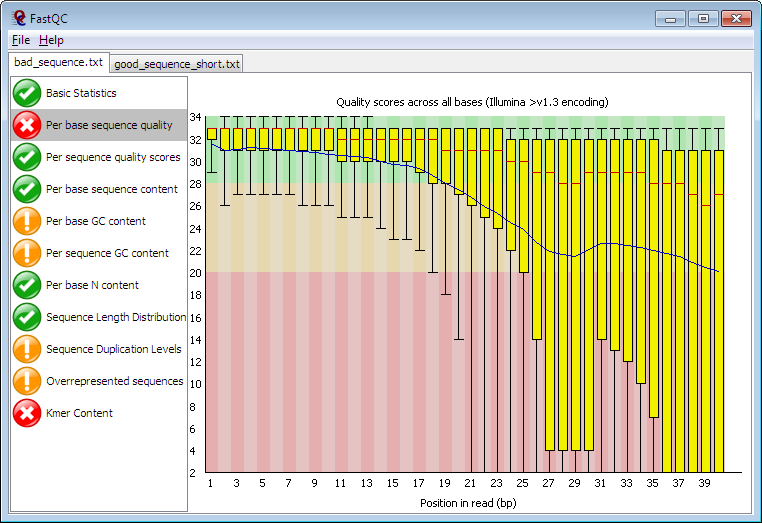
FastQC provides a series of quality-control modules for high-throughput sequencing data and can generate HTML reports suitable for automated workflows.
Typical QC metrics include:
Per-base sequence quality
This examines sequencing quality at each position of the reads.
Quality scores are usually represented using Phred-based values.
A simplified relationship is:
Q=−10log10(Pe)Q = -10 \log_{10}(P_e)
where PeP_e represents the estimated probability of an incorrect base call.
Higher Phred scores correspond to lower expected error rates.
GC content
The GC distribution can help identify:
- Library bias
- Contamination
- Unexpected sample composition
- Amplification-related artifacts
Sequence duplication
High duplication levels may indicate:
- PCR amplification
- Low library complexity
- Target enrichment effects
- Extremely deep sequencing
- Technical artifacts
Adapter contamination
Residual sequencing adapters can interfere with downstream alignment and should be evaluated carefully.
N-content
A high proportion of undetermined bases may indicate sequencing-quality problems.
Sequence length distribution
This helps verify whether read lengths correspond to the expected sequencing design.
Importantly, FastQC warnings should not automatically be interpreted as evidence that a sample has failed. The FastQC documentation emphasizes that results should be interpreted in the context of the expected library and experimental design.
Step 3: Adapter Trimming and Read Preprocessing
If adapters or poor-quality bases are present, reads may be trimmed before alignment.
Common tools include:
- Cutadapt
- Trim Galore
- fastp
- Trimmomatic
A preprocessing stage may perform:
- Adapter removal
- Quality trimming
- Minimum-length filtering
- Removal of unwanted sequences
- Read correction in specialized workflows
For example:
Raw FASTQ
   ↓
Adapter removal
   ↓
Quality trimming
   ↓
Filtered FASTQ
However, trimming should not be performed blindly.
Aggressive trimming can remove useful sequence information and potentially reduce alignment quality. Therefore, trimming parameters should be validated against the sequencing technology and library preparation method.
Step 4: Read Alignment to a Reference Genome
For many DNA-sequencing workflows, the next major stage is alignment.
The objective is to determine where each sequencing read originates within a reference genome.
For short-read DNA sequencing, commonly used aligners include:
- BWA-MEM
- BWA-MEM2
- Bowtie2
- DRAGMAP
- Minimap2 for certain sequencing technologies and applications
The output is typically SAM/BAM/CRAM.
A simplified workflow is:
FASTQ
  ↓
Read Alignment
  ↓
SAM/BAM/CRAM
The reference genome must be explicitly defined.
For human genomic analysis, examples include:
- GRCh37
- GRCh38
Using different reference assemblies can produce different coordinates and affect downstream annotation.
Therefore, a production pipeline should never silently change its reference genome.
The reference genome, genome indexes, annotation resources, and versions should be explicitly versioned.
Step 5: BAM Processing
After alignment, the resulting alignment file typically requires several processing steps.
A common sequence is:
SAM
 ↓
BAM
 ↓
Coordinate Sorting
 ↓
Duplicate Marking
 ↓
Indexing
 ↓
Alignment QC
Sorting
Reads are usually sorted according to genomic coordinates.
Duplicate marking
PCR amplification can produce multiple sequencing reads originating from the same original DNA fragment.
These reads can artificially increase apparent evidence for a variant.
Picard’s MarkDuplicates identifies and marks duplicate reads in SAM/BAM data and can also generate duplication metrics.
Importantly, duplicates should not always be interpreted in exactly the same way across sequencing applications. For example, targeted sequencing, RNA-seq, and unique molecular identifier (UMI)-based workflows require application-specific considerations.
Step 6: Alignment Quality Control
After alignment, the pipeline should evaluate whether the reads mapped to the reference genome appropriately.
Useful metrics include:
- Mapping rate
- Properly paired reads
- Coverage depth
- Coverage uniformity
- Duplicate rate
- Insert size
- Mapping quality
- On-target rate
- Mean target coverage
- Percentage of target bases above coverage thresholds
For targeted sequencing, coverage metrics are particularly important.
For example:
Mean Coverage: 250×
≥20×: 99.1%
≥50×: 96.4%
≥100×: 91.2%
However, a high average depth does not necessarily guarantee good variant detection.
Coverage must also be sufficiently uniform.
A sample with 500× average coverage but poorly covered clinically relevant regions may be less useful than a sample with lower but more uniform coverage.
Step 7: Variant Calling
Variant calling is the stage where the pipeline attempts to identify genomic differences supported by the sequencing data.
For DNA sequencing, variants may include:
- SNVs
- Indels
- CNVs
- Structural variants
- Mitochondrial variants
Different variant types often require different algorithms.
For small germline variants, tools may include:
- GATK HaplotypeCaller
- DeepVariant
- FreeBayes
For somatic analysis, tools may include:
- Mutect2
- VarScan
- Strelka2
- other validated somatic callers
The output is frequently a VCF file.
GATK Best Practices describes variant discovery as a workflow in which sequencing data is first transformed into analysis-ready alignment files, followed by variant discovery and then filtering/annotation appropriate to the experimental design.
Germline Variant Calling
Germline pipelines are designed to identify variants inherited through the germline.
A simplified germline workflow can look like:
FASTQ
 ↓
QC
 ↓
Trimming
 ↓
Alignment
 ↓
Duplicate Marking
 ↓
BQSR / Calibration where applicable
 ↓
Variant Calling
 ↓
Genotype Refinement / Filtering
 ↓
Annotation
 ↓
Clinical or Biological Interpretation
For cohort analysis, the architecture may differ from single-sample analysis.
A production pipeline should therefore distinguish between:
- Single-sample analysis
- Trio analysis
- Family analysis
- Cohort analysis
Somatic Variant Calling
Somatic pipelines are substantially different because the objective is often to identify variants present in a tumor but absent or present at a substantially lower frequency in normal tissue.
A simplified tumor-normal workflow is:
Tumor FASTQ ──→ Tumor BAM ──→
                             Somatic Variant Calling
Normal FASTQ ─→ Normal BAM ─→
                             ↓
                         VCF
                             ↓
                        Annotation
                             ↓
                       Interpretation
Somatic analysis must account for:
- Variant allele frequency (VAF)
- Tumor purity
- Copy-number alterations
- Normal contamination
- Sequencing artifacts
- Oxidative artifacts
- Strand bias
- Mapping artifacts
Consequently, a germline pipeline should not simply be renamed a “somatic pipeline.”
Copy Number Variant Analysis
Small SNVs and indels are only one category of genomic variation.
Copy-number variants (CNVs) involve changes in the number of copies of genomic regions.
CNV analysis can be particularly important in:
- Cancer genomics
- Hereditary disease analysis
- Rare disease diagnostics
- Exome sequencing
- Targeted gene panels
CNV analysis can use information such as:
- Read depth
- B-allele frequency
- Allelic imbalance
- Paired-end information
- Split reads
The appropriate algorithm depends strongly on the sequencing design.
A pipeline designed for whole-genome sequencing cannot necessarily be applied directly to a targeted panel without modification.
Structural Variant Detection
Structural variants can include:
- Large deletions
- Insertions
- Inversions
- Duplications
- Translocations
They may require specialized approaches based on:
- Split-read evidence
- Discordant read pairs
- Local assembly
- Read-depth changes
Because structural variants can be difficult to represent using conventional small-variant models, they often require separate processing and interpretation workflows. GATK’s documentation also distinguishes structural and copy-number variation workflows from conventional short-variant discovery.
Step 8: Variant Filtering
Variant calling typically produces more candidates than are ultimately relevant.
Filtering is therefore essential.
Possible criteria include:
- Depth (DP)
- Genotype quality (GQ)
- Allele balance
- Mapping quality (MQ)
- Base quality
- Variant allele frequency
- Strand bias
- Population frequency
- Caller-specific quality metrics
A simplified example might be:
Candidate Variants
       ↓
Quality Filter
       ↓
Depth Filter
       ↓
Allele Frequency Filter
       ↓
Population Frequency Filter
       ↓
Clinically Relevant Variants
Filtering should be designed according to the biological question.
For example, a rare-disease workflow may prioritize rare variants with plausible inheritance models, while a cancer workflow may prioritize somatic variants with sufficient VAF and tumor relevance.
Step 9: Variant Annotation
A VCF file tells you that a genomic variant was detected.
It does not, by itself, tell you what that variant means biologically or clinically.
This is where annotation becomes important.
Variant annotation can provide information such as:
- Gene
- Transcript
- Exon
- Protein consequence
- Amino-acid change
- Population frequency
- Known disease association
- Clinical significance
- Literature references
- Conservation scores
- Functional prediction scores
Common annotation tools include:
- Ensembl Variant Effect Predictor (VEP)
- SnpEff
- ANNOVAR
Common databases and resources include:
- ClinVar
- dbSNP
- gnomAD
- OMIM
- COSMIC
- population-specific databases
- disease-specific databases
Annotation databases must also be versioned.
For example:
ClinVar version X
gnomAD version Y
Reference genome: GRCh38
VEP version Z
Without version control, reproducing a previous interpretation can become difficult.
Step 10: Clinical and Biological Interpretation
This is where the NGS pipeline moves from variant detection to knowledge generation.
Consider a variant:
Gene: ABCD1
Variant: c.XXXXC>T
The pipeline must determine:
- Is the variant rare?
- Is it previously reported?
- Is it associated with disease?
- What is its predicted molecular consequence?
- Is the gene relevant to the patient’s phenotype?
- Is the inheritance pattern compatible?
- Are there functional studies?
- Is there supporting literature?
- Does the phenotype match?
For clinical genomics, variant interpretation may involve established frameworks such as ACMG/AMP recommendations.
Automated filtering can dramatically reduce the number of variants requiring manual review.
For example:
100,000+ raw genomic variants
            ↓
Quality filtering
            ↓
Population filtering
            ↓
Inheritance filtering
            ↓
Gene/phenotype filtering
            ↓
Potentially relevant variants
            ↓
Expert review
AI-Assisted NGS Data Analysis
The increasing scale of genomic data has created a strong need for intelligent analysis systems.
Traditional NGS analysis often requires the user to manually:
- Define filters.
- Search databases.
- Compare phenotypes.
- Examine gene-disease relationships.
- Review literature.
- Prioritize candidate variants.
AI and machine-learning approaches can assist in several parts of this process.
Potential applications include:
- Variant prioritization
- Phenotype-gene matching
- Candidate gene ranking
- Automated annotation
- Natural-language phenotype processing
- Literature analysis
- Pattern recognition
- Classification support
- Report generation
However, AI should generally be viewed as an assistance and prioritization layer, not as an unquestioned replacement for validated analytical procedures or expert interpretation.
Where Does NGS Cloud Fit Into an NGS Pipeline?
Cloud-based platforms can combine multiple components of an NGS workflow into a centralized analysis environment.
NGS Cloud is an AI-supported, cloud-based genetic data analysis platform developed by PairEnd Biotechnology. Its platform architecture is designed to bring raw-data processing, analysis, and interpretation into an integrated environment.
A conventional NGS workflow may require users to manage:
Command-line tools
+
Reference genomes
+
Annotation databases
+
Computational infrastructure
+
Storage
+
Pipeline scripts
+
QC reports
+
Variant filtering
+
Interpretation
A cloud-based platform can abstract much of this infrastructure from the end user.
For example, NGS Cloud provides solutions such as:
- GENIUS for AI-supported candidate variant prioritization based on clinical data
- HOPE for connecting disease, clinical-feature, gene, and ontology relationships
- PECULIAR for raw-data upload and integrated analysis
These capabilities illustrate how a modern NGS platform can extend beyond conventional secondary analysis toward automated tertiary analysis and interpretation.
For laboratories that need to process multiple samples or support users who are not comfortable managing command-line bioinformatics environments, this type of architecture can reduce infrastructure and workflow-management complexity.
Designing an NGS Pipeline Architecture
A production-grade NGS pipeline should be designed as a collection of independent but connected modules.
A simplified architecture might look like this:
                    ┌─────────────────┐
                    │   Input Data    │
                    │ FASTQ / BAM     │
                    └────────┬────────┘
                             │
                             ▼
                    ┌─────────────────┐
                    │ Quality Control │
                    │    FastQC       │
                    └────────┬────────┘
                             │
                             ▼
                    ┌─────────────────┐
                    │ Pre-processing  │
                    │ Trimming / QC   │
                    └────────┬────────┘
                             │
                             ▼
                    ┌─────────────────┐
                    │    Alignment    │
                    │ BWA / DRAGMAP   │
                    └────────┬────────┘
                             │
                             ▼
                    ┌─────────────────┐
                    │ BAM Processing  │
                    │ Sort / Mark Dup  │
                    └────────┬────────┘
                             │
                             ▼
                    ┌─────────────────┐
                    │ Variant Calling │
                    │ GATK / Other    │
                    └────────┬────────┘
                             │
                             ▼
                    ┌─────────────────┐
                    │    Filtering    │
                    └────────┬────────┘
                             │
                             ▼
                    ┌─────────────────┐
                    │   Annotation    │
                    │ VEP / SnpEff    │
                    └────────┬────────┘
                             │
                             ▼
                    ┌─────────────────┐
                    │ Interpretation  │
                    │ AI / Databases  │
                    └────────┬────────┘
                             │
                             ▼
                    ┌─────────────────┐
                    │     Report      │
                    └─────────────────┘
This modular architecture makes it easier to replace individual components without redesigning the entire pipeline.
Choosing a Workflow Engine
A pipeline can theoretically be created using shell scripts, Python, Perl, or other programming languages.
However, complex production workflows benefit from dedicated workflow-management systems.
Popular options include:
- Nextflow
- Snakemake
- WDL
- Cromwell
- CWL
Nextflow is particularly popular in modern genomics because it separates workflow logic from the execution environment and can support local machines, HPC clusters, and cloud environments.
The nf-core ecosystem provides standardized practices for building modular, scalable, reproducible Nextflow pipelines. Its specifications recommend practices such as versioned dependencies, testing, documentation, cloud compatibility, and standardized pipeline structures.
Building an NGS Pipeline With Nextflow
A conceptual Nextflow architecture could look like:
main.nf
modules/
    fastqc.nf
    trimming.nf
    alignment.nf
    markduplicates.nf
    variant_calling.nf
    annotation.nf

conf/
    base.config
    local.config
    hpc.config
    cloud.config

data/
results/
Each process should ideally perform one clearly defined task.
For example:
FASTQC
   ↓
TRIMMING
   ↓
ALIGNMENT
   ↓
MARK_DUPLICATES
   ↓
VARIANT_CALLING
   ↓
ANNOTATION
The workflow engine manages dependencies and execution.
This means that if one sample fails during a particular process, the workflow can potentially resume from the relevant point rather than repeating the entire analysis.
Containers and Software Reproducibility
One of the most underestimated problems in bioinformatics is dependency management.
Suppose a pipeline uses:
BWA 0.x
GATK 4.x
Samtools 1.x
VEP x.x
Python 3.x
If software versions change, results may also change.
A robust pipeline therefore records:
- Tool name
- Tool version
- Reference version
- Database version
- Parameters
- Configuration
- Input files
- Output files
Container technologies such as:
- Docker
- Singularity/Apptainer
can help encapsulate software environments.
nf-core recommends reproducible software environments through tools such as Bioconda/BioContainers and containerized execution.
Reference Genome Management
Reference data is just as important as software versions.
A pipeline should explicitly manage:
- Reference genome FASTA
- FASTA index
- Sequence dictionary
- Alignment indexes
- Known-sites databases
- Gene annotation
- Variant databases
For example:
Reference:
GRCh38

Annotation:
GENCODE version X

Population database:
gnomAD version X

Clinical database:
ClinVar version X
Changing any of these resources can change downstream results.
Therefore, references should be treated as versioned pipeline dependencies rather than static files sitting on a server.
Pipeline Configuration
A professional pipeline should avoid hard-coded parameters.
Instead of embedding:
/reference/GRCh38.fa
directly into multiple scripts, the pipeline should define configurable parameters.
For example:
--reference
--input
--output
--threads
--memory
--variant_caller
--annotation_database
This allows the same pipeline to be used in different environments.
For example:
Local workstation
        ↓
HPC cluster
        ↓
Cloud infrastructure
without changing the core workflow logic.
Resource Management
NGS analysis can be computationally demanding.
Whole-genome sequencing may require:
- Large storage capacity
- High CPU availability
- Significant RAM
- High-performance storage
- Parallel execution
A pipeline should therefore define resource requirements per process.
For example:
FastQC          → Low CPU / Low RAM
Alignment       → High CPU / Moderate RAM
Variant Calling → High CPU / High RAM
Annotation      → Moderate CPU / Variable RAM
Workflow engines can then allocate resources dynamically.
This becomes particularly important when hundreds or thousands of samples are processed simultaneously.
Parallelization
A major advantage of workflow engines is parallel processing.
Suppose a laboratory has 100 samples.
Instead of:
Sample 1 → Complete
Sample 2 → Complete
Sample 3 → Complete
...
the pipeline can process multiple samples concurrently:
Sample 1 ─┐
Sample 2 ─┤
Sample 3 ─┤
Sample 4 ─┼──→ Alignment
Sample 5 ─┤
Sample 6 ─┤
Sample 7 ─┘
This dramatically reduces turnaround time when sufficient computational resources are available.
Pipeline Validation
Before using an NGS pipeline for research or clinical analysis, it should be validated.
Validation may include:
Analytical accuracy
Can the pipeline correctly identify known variants?
Precision
How many reported variants are actually correct?
Recall / sensitivity
How many true variants are detected?
Reproducibility
Does the same input produce the same result?
Robustness
Does the pipeline behave correctly when:
- Coverage is low?
- Files are incomplete?
- Samples contain unusual GC content?
- Data comes from another sequencing batch?
- One computational process fails?
Performance
How long does the pipeline take?
How much CPU, RAM, storage, and network bandwidth does it consume?
Test Datasets
A production pipeline should have small test datasets.
A developer should be able to execute something like:
nextflow run pipeline.nf -profile test
and verify that:
- All expected processes execute.
- Outputs are generated.
- Files are valid.
- QC metrics are reasonable.
- Variant calls are consistent.
The nf-core ecosystem explicitly recommends automated testing with tools such as nf-test for validating pipeline behavior.
Monitoring and Reporting
An NGS pipeline should generate more than a VCF file.
Useful outputs include:
- QC reports
- Alignment metrics
- Coverage reports
- Variant statistics
- Annotation summaries
- Software versions
- Execution logs
- Resource usage
- Pipeline version
- Reference versions
A summary report can provide a high-level view:
Samples processed: 48
Samples passed QC: 46
Samples failed QC: 2

Mean coverage: 182×
Mean mapping rate: 98.4%

Variants detected: 21,438
High-confidence variants: 18,921
Annotated variants: 18,754
Candidate variants: 37
This makes the pipeline substantially easier to audit.
Data Provenance and Traceability
For clinical and research environments, knowing how a result was generated is critical.
For every result, it should ideally be possible to answer:
- Which sample produced this result?
- Which FASTQ files were used?
- Which reference genome was used?
- Which software versions were used?
- Which parameters were applied?
- Which annotation databases were used?
- When was the analysis executed?
- Which pipeline version produced the result?
This is known as data provenance.
Modern workflow frameworks can record relationships between inputs, processes, parameters, and outputs. Nextflow’s lineage capabilities are specifically designed to help trace results back to the analysis execution that generated them.
MultiQC and Aggregated Quality Control
When dozens or hundreds of samples are analyzed, reviewing individual QC reports becomes inefficient.
Tools such as MultiQC can aggregate results from multiple bioinformatics tools into a single report.
A laboratory might therefore have:
Sample 001 FastQC
Sample 002 FastQC
Sample 003 FastQC
...
Sample 100 FastQC

          ↓

       MultiQC

          ↓

One integrated QC report
This makes it easier to identify:
- Outlier samples
- Batch effects
- Coverage problems
- Unexpected duplication
- GC-content anomalies
- Systematic sequencing issues
Common Mistakes When Building NGS Pipelines
Mistake 1: Treating every NGS dataset identically
Whole-genome, whole-exome, targeted-panel, RNA-seq, and single-cell data require different analytical strategies.
Mistake 2: Ignoring sample metadata
Without reliable metadata, downstream interpretation can become error-prone.
Mistake 3: Hard-coding file paths
Hard-coded paths make pipelines difficult to deploy and reproduce.
Mistake 4: Not versioning databases
Annotation results can change as databases evolve.
Mistake 5: Ignoring QC
A pipeline that produces a VCF is not necessarily a good pipeline.
The quality of the input data and intermediate results must be monitored.
Mistake 6: Using inappropriate filtering thresholds
Filtering parameters should reflect the sequencing technology, assay, and biological question.
Mistake 7: Treating AI predictions as definitive clinical conclusions
AI can help prioritize candidates, identify relationships, and accelerate interpretation. However, clinical conclusions require appropriate validation, evidence assessment, and professional review.
Mistake 8: Building a monolithic script
A 5,000-line script that performs every operation is difficult to maintain.
Modular processes are usually easier to test, replace, debug, and scale.
NGS Pipeline vs NGS Platform
It is important to distinguish between an NGS pipeline and an NGS analysis platform.
An NGS pipeline is primarily a workflow.
An NGS platform may provide:
- Data storage
- Workflow execution
- User management
- Sample management
- Pipeline selection
- QC visualization
- Variant interpretation
- Database integration
- Reporting
- Cloud infrastructure
- AI-assisted analysis
For example, instead of manually executing:
FastQC
↓
BWA
↓
Samtools
↓
GATK
↓
VEP
↓
Custom filtering
a platform can expose the same analytical architecture through a graphical interface.
This is particularly useful for laboratories that want standardized workflows without requiring every user to operate command-line tools.
How AI Can Change the Tertiary Analysis Layer
The most interesting development in NGS analysis is arguably not the generation of sequencing data itself, but the increasing automation of the interpretation layer.
Traditional tertiary analysis often requires researchers to manually connect:
Variant
   ↓
Gene
   ↓
Disease
   ↓
Phenotype
   ↓
Literature
   ↓
Clinical relevance
AI can help create these connections automatically.
For example:
Patient phenotype
       ↓
AI-assisted phenotype analysis
       ↓
Candidate genes
       ↓
Candidate variants
       ↓
Evidence aggregation
       ↓
Prioritized candidates
       ↓
Expert review
NGS Cloud‘s GENIUS solution, for example, is positioned as an AI-supported system that can use submitted clinical data to generate candidate variant lists without requiring the user to manually construct traditional filtering workflows.
Its HOPE solution is designed around relationships between disease concepts, clinical features, genes, and ontologies, illustrating another important direction in genomic interpretation: connecting heterogeneous biomedical knowledge rather than treating variants as isolated records.
A Complete Example: Germline Rare Disease Pipeline
Consider a patient undergoing whole-exome sequencing.
The pipeline might be:
Patient Sample
      ↓
Sequencing
      ↓
FASTQ
      ↓
Raw QC
      ↓
Adapter / Quality Processing
      ↓
Reference Alignment
      ↓
BAM Processing
      ↓
Coverage Analysis
      ↓
Germline Variant Calling
      ↓
SNV / Indel Filtering
      ↓
CNV Analysis
      ↓
Variant Annotation
      ↓
Population Frequency Filtering
      ↓
Phenotype / Gene Prioritization
      ↓
Candidate Variants
      ↓
Expert Review
      ↓
Clinical Report
An AI-assisted platform can potentially automate a significant portion of the candidate-prioritization layer after the technically validated sequencing analysis has been completed.
A Complete Example: Hereditary Cancer Pipeline
A hereditary cancer pipeline may look like:
FASTQ
 ↓
QC
 ↓
Trimming
 ↓
Alignment
 ↓
BAM Processing
 ↓
Coverage QC
 ↓
SNV/Indel Calling
 ↓
CNV Calling
 ↓
Variant Annotation
 ↓
Population Frequency Filtering
 ↓
Cancer Gene Filtering
 ↓
ACMG/AMP Evidence Assessment
 ↓
Candidate Prioritization
 ↓
Clinical Review
 ↓
Report
Genes and interpretation rules would depend on the specific clinical indication and panel design.
A Complete Example: Somatic Cancer Pipeline
A tumor-normal workflow may be:
Tumor FASTQ ──→ QC ──→ Alignment ──→ Tumor BAM
                                            │
                                            ▼
                                      Somatic Calling
                                            ▲
                                            │
Normal FASTQ ──→ QC ──→ Alignment ──→ Normal BAM

                                            ↓
                                      Variant Filtering
                                            ↓
                                         VAF/QC
                                            ↓
                                         CNV/SV
                                            ↓
                                        Annotation
                                            ↓
                                     Cancer Databases
                                            ↓
                                     Interpretation
Such a pipeline requires tumor-specific quality metrics and filtering strategies.
Designing a Production-Ready NGS Pipeline: Recommended Checklist
Before deploying an NGS pipeline, ask the following questions.
Data
- What sequencing technology is being used?
- Is the data single-end or paired-end?
- What is the expected read length?
- What is the expected coverage?
- What type of assay is being analyzed?
Reference
- Which reference genome is used?
- Is the reference version fixed?
- Are indexes available?
- Are annotation resources versioned?
QC
- What metrics determine sample quality?
- Which thresholds are applied?
- Are QC failures automatically detected?
Analysis
- Which aligner is used?
- Which variant caller is used?
- Which algorithms detect CNVs and SVs?
- How are variants filtered?
Annotation
- Which databases are used?
- Which versions are used?
- How frequently are databases updated?
Reproducibility
- Are software versions recorded?
- Are containers used?
- Is the pipeline version-controlled?
- Are parameters stored?
Scalability
- Can the pipeline process one sample?
- Can it process 1,000 samples?
- Can it run on HPC?
- Can it run in the cloud?
Security
- How is genomic data protected?
- Is access controlled?
- Are data transfers encrypted?
- Are audit logs available?
Reporting
- Is a machine-readable output generated?
- Is a human-readable report generated?
- Are QC metrics included?
- Are software and database versions recorded?
What Makes a Good NGS Pipeline?
A good NGS pipeline is not simply a collection of popular bioinformatics tools.
It should have six fundamental characteristics:
Accuracy
The pipeline should produce analytically reliable results.
Reproducibility
The same input and configuration should produce the same or appropriately equivalent result.
Scalability
The pipeline should be capable of processing both small and large datasets.
Maintainability
Individual tools should be replaceable without redesigning the entire workflow.
Traceability
Every result should be traceable to its source data, software, parameters, and reference resources.
Interpretability
The pipeline should ultimately help users move from sequencing data toward meaningful biological or clinical conclusions.
The Future of NGS Pipelines
NGS pipelines are evolving from collections of command-line tools into integrated computational ecosystems.
The next generation of genomic analysis platforms will increasingly combine:
- Workflow automation
- Cloud computing
- Containerization
- AI-assisted interpretation
- Knowledge graphs
- Phenotype-driven analysis
- Automated quality control
- Large-scale genomic databases
- Reproducible research frameworks
- Interactive reporting
This evolution is particularly important because sequencing capacity continues to increase while the amount of biological information that must be interpreted grows even faster.
The challenge is therefore shifting from:
“How can we sequence more data?”
to:
“How can we transform increasingly large amounts of genomic data into reliable and actionable knowledge?”
AI-assisted platforms such as NGS Cloud represent one approach to this problem by integrating raw-data analysis with higher-level genomic interpretation within a cloud environment.
At the same time, open workflow ecosystems such as Nextflow and nf-core are helping establish standards for reproducible, portable, modular, and scalable bioinformatics pipelines.
Conclusion
An NGS pipeline is the computational backbone that transforms sequencing data into useful genomic information.
A typical pipeline may include:
FASTQ → QC → Preprocessing → Alignment → BAM Processing → Variant Calling → Filtering → Annotation → Interpretation → Reporting
However, a truly production-ready NGS pipeline requires much more than connecting a few bioinformatics tools.
It must address:
- Data quality
- Reference genome management
- Software versions
- Computational resources
- Reproducibility
- Scalability
- Data provenance
- Validation
- Annotation
- Biological interpretation
- Security
- Reporting
For research environments, pipelines provide automation and reproducibility. For clinical genomics, they additionally need rigorous validation, traceability, appropriate quality controls, and carefully defined interpretation procedures.
Modern platforms such as NGS Cloud extend this model by combining cloud-based genomic analysis with AI-assisted interpretation capabilities, helping bridge the gap between raw sequencing data and prioritized biological or clinical insights.
Ultimately, the goal of an NGS pipeline is not simply to generate a VCF, BAM, or expression matrix.
The real goal is to create a reliable and reproducible path from raw sequencing data to scientifically meaningful knowledge.
References and Further Reading
- Broad Institute – GATK Best Practices
GATK Best Practices provides reference workflows and recommendations for high-throughput sequencing variant discovery, including preprocessing, variant discovery, filtering, and annotation. GATK Best Practices - Illumina – Sequencing Data Analysis
Overview of primary, secondary, and tertiary NGS analysis and common sequencing-data processing stages. Illumina Sequencing Data Analysis - Illumina – NGS Workflow
Overview of the NGS workflow and the transition from sequencing to data analysis. Illumina NGS Workflow - FastQC – Babraham Bioinformatics
Documentation for quality-control analysis of high-throughput sequencing data. FastQC - Picard – MarkDuplicates Documentation
Documentation describing duplicate-read identification and marking in SAM/BAM data. Picard Documentation - BCFtools Documentation
Documentation for manipulating and processing VCF and BCF variant files. BCFtools - Nextflow / nf-core
Guidelines and best practices for building reproducible, modular, scalable bioinformatics pipelines. nf-core Documentation - Nextflow and nf-core – Reproducible Bioinformatics Workflows
Discussion of workflow reproducibility, provenance, configuration, and scalable execution. - NGS Cloud – AI-Supported Genetic Data Analysis Platform
Information about NGS Cloud and its AI-supported genomic analysis solutions, including GENIUS, HOPE, and PECULIAR.NGS Cloud
